


Migration to AWS
with 21% Lower Cloud Spend
Silencio is a technology company operating in the environmental data and smart cities domain, specializing in the collection, processing, and monetization of large volumes of noise measurement data. Through mobile applications, geospatial processing, and data analytics, Silencio’s platform enables organizations and municipalities to understand urban noise patterns and their impact across different environments.
Customer Context and Business Challenge
At the beginning of the project, Silencio’s primary application, critical to daily operations and revenue generation, was running on Google Cloud Platform (GCP). The platform processed large volumes of geolocation-based data and served multiple consumption channels, including mobile applications and a web interface, forming the core of the company’s business model.
As Silencio began to define a global growth strategy, relevant limitations emerged in the existing environment. In particular, the available regional coverage and the operational complexity required to deploy and operate the platform consistently across multiple regions made international expansion more challenging. The company required a cloud infrastructure that would allow workloads to be deployed in an agile and consistent manner across different regions worldwide, while maintaining uniform operational, security, and availability standards.
From an operational perspective, the GCP environment relied heavily on manually provisioned resources, with a low level of infrastructure standardization. Monitoring, observability, and operational governance capabilities were limited and fragmented, increasing operational risk as platform traffic and data volumes continued to grow.
Additionally, from a business and financial standpoint, Silencio identified the need to optimize infrastructure costs in order to reallocate budget toward innovation initiatives. The approximate monthly infrastructure spend on GCP was USD 11000, which constrained the company’s ability to invest in advanced data analytics processes, data cleansing, and experimentation with new features.
In this context, Silencio sought a cloud platform that not only offered broader global coverage, but also enabled the adoption of managed and specialized services for analytics, data processing, and observability, reducing the operational burden on the internal team and accelerating innovation. As part of the pre-migration analysis, it was determined that a replatform strategy on AWS could optimize infrastructure operating costs, with an estimated target reduction to less than USD 10000 per month, and allow the remaining budget to be allocated to testing new functionalities and data analytics initiatives.
These technical, operational, and business challenges led Silencio to define a migration strategy focused on a replatform approach to Amazon Web Services (AWS), with the objective of modernizing its cloud operational foundation, supporting a global expansion strategy, and enabling new analytics and innovation capabilities, while ensuring business continuity and minimizing impact on end users.
Migration Strategy and Replatform Approach
Based on the challenges identified during the initial analysis phase, a migration strategy was defined using a replatform approach, prioritizing the modernization of the platform’s operational foundation without introducing disruptive changes to the application’s core business logic.
As a first step, a technical and operational discovery process was conducted, focused on assessing the customer’s infrastructure, workloads, and operational processes. For this purpose, Teracloud applied a standardized and repeatable methodology that combines an automated assessment tool (CloudFit) with structured discovery workshops.
CloudFit leverages a custom lens built on AWS Well-Architected Tool, developed by Teracloud and aligned with the AWS Well-Architected Framework. This custom lens provides a consistent mechanism to evaluate workloads across multiple architectural dimensions, enabling an objective assessment of current-state practices related to architecture, operations, security, and performance.
This discovery process made it possible to establish a clear baseline of the existing workload, identify operational risks, and highlight improvement opportunities relevant to the migration strategy. The findings were further complemented with the information gathered during the project scoping phase and formally documented in the Statement of Work (SoW).
Based on the results of this assessment, a rehost approach was discarded, as it would not adequately address the identified challenges related to standardization, observability, and scalability. A full refactor was also ruled out due to the potential impact on project timelines and the risk it would introduce to business continuity. The replatform approach was therefore selected as the most appropriate strategy, allowing architectural and operational improvements through the adoption of AWS managed services while preserving the application’s existing functionality.
The migration strategy was designed to be executed in a controlled and progressive manner, with a strong focus on:
-
Reducing operational risk throughout the transition.
-
Ensuring service continuity for end users.
-
Establishing a cloud foundation aligned with AWS best practices from the outset.
As part of this strategy, a target architecture on AWS was defined with the following principles:
- Adoption of a multi-account model to separate environments and improve governance and security.
-
Use of AWS managed services to reduce the operational burden on the internal team.
-
Standardization of deployments and configurations to support consistent operations across multiple regions.
-
Preparation of the platform to support future data analytics initiatives and advanced data processing capabilities.
Additionally, the replatform strategy considered AWS’s global regional footprint as a key enabler for Silencio’s international expansion plans, allowing the architecture to be designed in a way that can be consistently replicated across regions in a predictable and scalable manner.
This approach enabled Silencio to move toward a more resilient and scalable platform, aligned with its global growth strategy, while establishing the technical and operational foundations required for continuous optimization and the adoption of new capabilities on AWS.
Execution Overview
Project Scope and Migration Phases
This engagement was executed following a structured migration lifecycle aligned with AWS best practices, covering the Assess, Mobilize, Migrate, and Modernize phases as defined in the agreed Statement of Work. The project entered production on June 2025, with the core production workload fully operational on AWS.
Teracloud executed a structured replatform approach to migrate Silencio’s core production workload from Google Cloud Platform (GCP) to Amazon Web Services (AWS). The execution focused on modernizing the operational foundation of the platform while preserving the existing application logic to minimize business disruption.
The migration leveraged a standardized multi-account AWS environment and Infrastructure as Code (Terraform) to ensure repeatability, consistency, and operational governance. Managed AWS services were adopted where applicable to reduce operational overhead, improve observability, and enable scalable deployments across multiple regions.
The solution was designed and implemented following AWS best practices, with the primary goal of achieving measurable business outcomes, which are reflected in the KPIs described below.
Organizational Diagram

Architecture Diagram
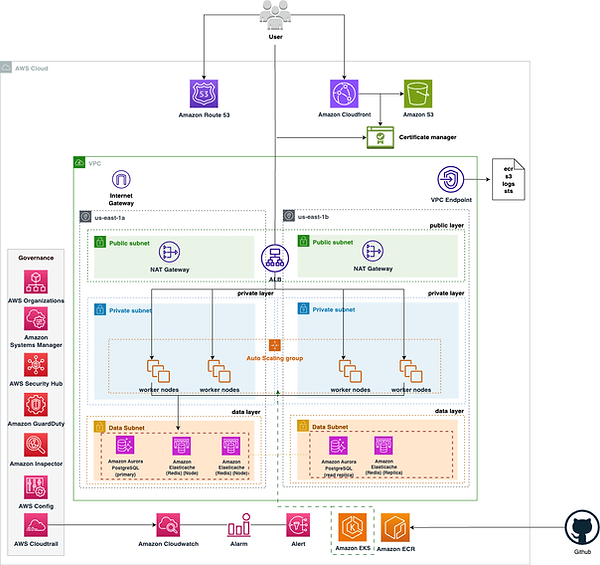
Key Technologies Implemented
Amazon Route 53 | Amazon Cloudfront | Amazon S3 | VPC | ALB | Amazon EC2 | Amazon Aurora PostgresSQL | Amazon Elasticache |
Amazon EKS | Amazon ECR | Amazon CloudWatch | AWS Organizations | Amazon System Manager | AWS Security Hub | Amazon GuardDuty | Amazon Inspector | AWS Config | AWS Cloudtrail
Key Performance Indicators
As part of the migration and replatform initiative to AWS, Teracloud and Silencio defined a set of Key Performance Indicators (KPIs) to objectively measure the business and operational impact of the solution. These KPIs were selected to directly align with Silencio’s strategic goals of cost optimization, global scalability, and accelerated innovation.
The KPIs were measured by comparing baseline metrics from the previous Google Cloud Platform (GCP) environment against the post-migration AWS environment, using consistent measurement methodologies to ensure accuracy and auditability.
KPI 1 – Monthly Infrastructure Cost Optimization
Objective
Reduce monthly infrastructure operating costs in order to reallocate budget to innovation, data analytics initiatives, and new feature experimentation.
Improvement Achieved
-
Approximate 21% reduction in monthly infrastructure costs.
-
The cost optimization exceeded initial expectations.
Measurement Methodology
Monthly infrastructure costs were measured using:
-
Billing report from Google Cloud Platform (pre-migration) provided by the customer during discovery.
-
AWS Cost Explorer and consolidated billing reports (post-migration).
Costs were normalized to include only the resources supporting the core production workload to ensure a like-for-like comparison.
Business Impact
The reduction in infrastructure spend enabled Silencio to:
-
Reallocate budget to advanced analytics and data processing initiatives.
-
Fund experimentation with new features and data-driven services.
-
Improve financial predictability without increasing total cloud spend.
KPI 2 – Global Deployment Capability and Time-to-Deploy Reduction
Objective
Enable rapid and repeatable deployment of the platform in new geographic regions to support Silencio’s global expansion strategy.
Baseline (Pre-migration – GCP)
-
Manual regional deployments.
-
Provisioning and configuration required multiple weeks per region.
-
High operational effort and configuration inconsistency risk.
Target
-
Enable standardized regional deployments in less than 1 week.
Actual Result (Post-migration – AWS)
-
Platform deployment completed in under 1 day using Infrastructure as Code.
-
KPI validated through a controlled deployment test in the AWS US East (N. Virginia) region.
Measurement Methodology
Deployment time was measured from the initiation of Infrastructure as Code execution until the environment was fully provisioned and ready to host the workload.
Business Impact
This capability allows Silencio to:
-
Accelerate entry into new global markets.
-
Reduce time-to-market from weeks to days.
-
Scale internationally using a consistent and predictable operating model.
Summary
The defined KPIs demonstrate that the AWS replatform initiative delivered clear and measurable business value. The solution exceeded cost optimization targets while establishing a globally scalable, automated foundation that supports Silencio’s long-term growth and innovation strategy.
Get in touch
Take your business to the next level.